How Fancy Text Works: It Is Unicode, Not a Font
Paste 𝓗𝓮𝓵𝓵𝓸 into an Instagram bio and it stays in script, even though Instagram has no font menu. Paste it into a plain text file and it is still script. That is because fancy text is not a font at all. This guide explains how fancy text works, where the letters come from and why they sometimes misbehave.
Fonts versus characters
Every piece of text on a screen is two things: a list of characters and a font that draws them. The character is the idea of “capital A”. The font decides what that A looks like: Arial, Times New Roman, Comic Sans.
When you choose bold in a word processor, the characters stay the same and the program remembers “draw these in bold”. That instruction is formatting, and it is lost the moment you paste into a place that does not support formatting, such as a bio or a username.
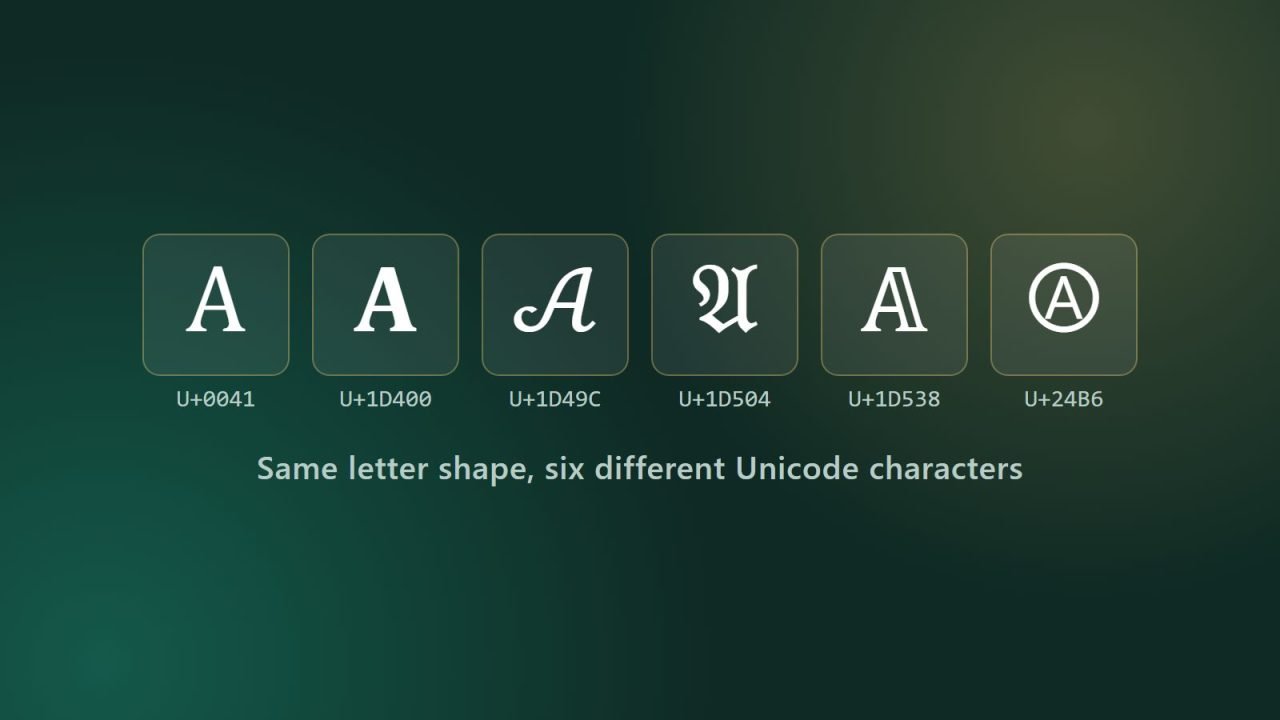
A fancy text generator does something different. It replaces each character with a different character that already looks styled. 𝐀 is not a bold A; it is its own character, called MATHEMATICAL BOLD CAPITAL A. Because the style lives in the character itself, it travels anywhere text can go.
Where the fancy letters come from
Unicode is the standard that gives every character in every writing system a number, called a code point. It has room for over a million characters and today defines more than 150,000. Among them are several sets of letters that just happen to look like styled Latin letters.
Mathematical alphanumeric symbols
Mathematicians use letter styles as meaning. A bold v can be a vector, a script L can be a special function, and a double-struck ℝ means the real numbers. To let them write formulas in plain text, Unicode 3.1 added a block of nearly a thousand styled letters and digits in 2001: bold, italic, bold italic, script, bold script, Fraktur (gothic), bold Fraktur, double-struck, sans-serif in four weights, and monospace.
This one block provides most of the styles on a fancy text site. It is also why some styles have holes. A few letters, such as script ℬ and ℰ, Fraktur ℭ and ℌ, and double-struck ℂ and ℕ, already existed in an older block called Letterlike Symbols, so Unicode did not encode them twice. Generators fill the holes from that older block, which is why those letters can look slightly different on some devices.
Enclosed letters
Circled letters such as Ⓐ, parenthesized letters such as ⒜ and squared letters such as 🄰 were added for compatibility with older East Asian character sets, where they were used for lists and labels. Black circled and black squared capitals (🅐, 🅰) came later, from symbol sets used in Japanese television broadcasting.
Small caps and superscripts
Small capitals like ᴀ and ʙ, and tiny raised letters like ᵃ and ᵇ, come from phonetic alphabets that linguists use to write down speech sounds. Because they were added for that purpose and not for styling, the sets are incomplete. There is no true superscript q and only 17 letters have subscript forms.
Full-width letters
Abc are full-width forms, designed to line up with Chinese, Japanese and Korean characters in old computer systems. Their wide spacing is what gives “vaporwave” text its look.
How a generator builds the text
A generator is a lookup table. For each style it has a list that maps a to 𝐚, b to 𝐛 and so on. When you type, it goes through your text one character at a time and swaps any character it has a match for. Spaces, punctuation and letters with no styled version are left alone, which is why accents and most punctuation stay plain.
Some styles add characters instead of swapping them. Strikethrough and underline add an invisible combining mark after each letter (U+0336 and U+0332), which the device draws through or under the letter before it. Decorations simply add symbols such as ★ or ꧁ at the start and end.
Why fancy text sometimes breaks
- Missing glyphs. Your device needs a font that contains each character. If none does, you see an empty box. Read why fancy text shows as boxes for fixes.
- Search and sorting. To a computer, 𝐀 and A are different characters. Searching for “hello” will usually not find 𝐡𝐞𝐥𝐥𝐨, and some apps sort fancy names after Z.
- Screen readers. Many read the character names aloud or skip the letters. See is fancy text accessible?
- Length. Most fancy letters sit outside Unicode’s first 65,536 code points. Many systems store them as two units instead of one, so they can count double against character limits.
Is it allowed?
The characters are part of an open standard, so anyone can use them, and there is no font licence involved. Platforms decide what they accept in usernames and names, so some will reject fancy letters. What is never fine is using look-alike letters to impersonate someone or disguise a link.
Try it
Type a word into the fancy text generator and you can see every style side by side. If you want just one style, try the bold, cursive or Old English generators.